Communities in Blantyre District have commended the Social Cash Transfer Programme, widely known as Mtukula Pakhomo, for empowering them to overcome extreme poverty and rebuild their lives.
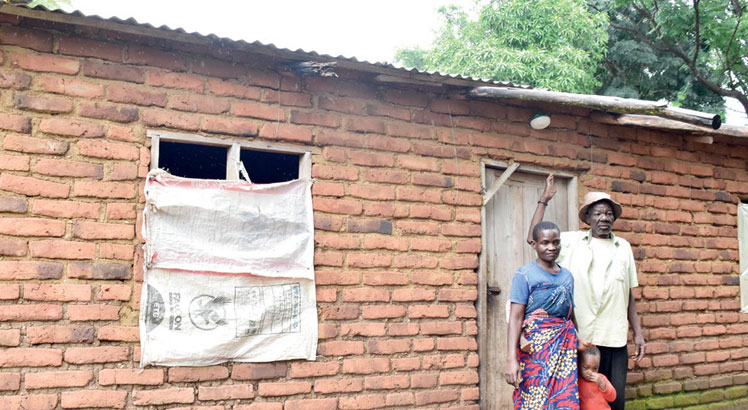
Anderson Masuwesi, from Traditional Authority (T/A) Somba, said his life has transformed since joining the programme in August last year.
his house. | Margaret Mbendela
He recalled that before his enrolment, his family faced a housing crisis as in June last year, part of their three-bedroom house collapsed during persistent rains, leaving the family cramped into a single bedroom.
“My wife, three grandchildren and I were forced to squeeze into the single bedroom that remained standing. I had hoped that income from piecework would help rehabilitate the house, but the money I earned was not enough to feed my family, let alone do the work,” said Masuweni.
He said the social safety net initiative provided the financial stability he needed to rebuild.
“Between August and December, I received nearly K250 000, which I used to complete construction of a permanent home and invest in livestock,” said Masuweni.
Another beneficiary, Agnes Lucius, also from T/A Somba, said the programme helped her to break free from the cycle of poverty.
She said she had struggled significantly following her husband’s death, but praised the programme for enabling her to accumulate household assets and livestock to support her family of four.
Blantyre district chief social welfare officer Kumbukeni Kauwa noted that the programme has significantly improved the lives of ultra-poor and labour-constrained households.
“Beneficiaries are now able to meet basic needs such as food, clothing and shelter. In addition, the programme has contributed to improved food security and increased school enrolment and attendance among children,” he said.
Kauwa further stated that the programme has enhanced healthcare access and reduced reliance on negative coping mechanisms such as child labour and begging.
Funded by the World Bank, the programme currently supports 11 713 households in the district’s eight T/As.